The Rialto Bridge
Exploring the Rialto Bridge in Venice: History, Views & Nearby Attractions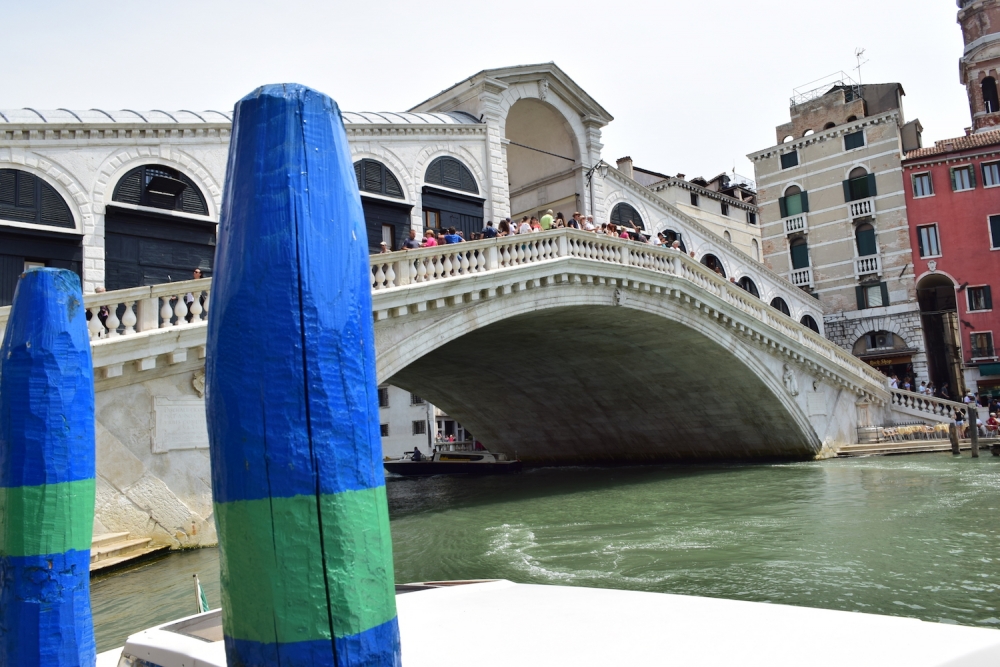

The oldest bridge on the Grand Canal
The Rialto Bridge isn't just a bridge — it's the point around which Venice was built.
For centuries before the first stone arch went up, this bend in the Grand Canal was the economic heart of the Republic. The market on the San Polo side drew merchants from across the known world. The bridge that finally replaced the old wooden structure in 1591 — designed by Antonio da Ponte after a competition that pitted him against Michelangelo, Palladio, and Sansovino — was built to be worthy of that history.
It holds its own, even now.
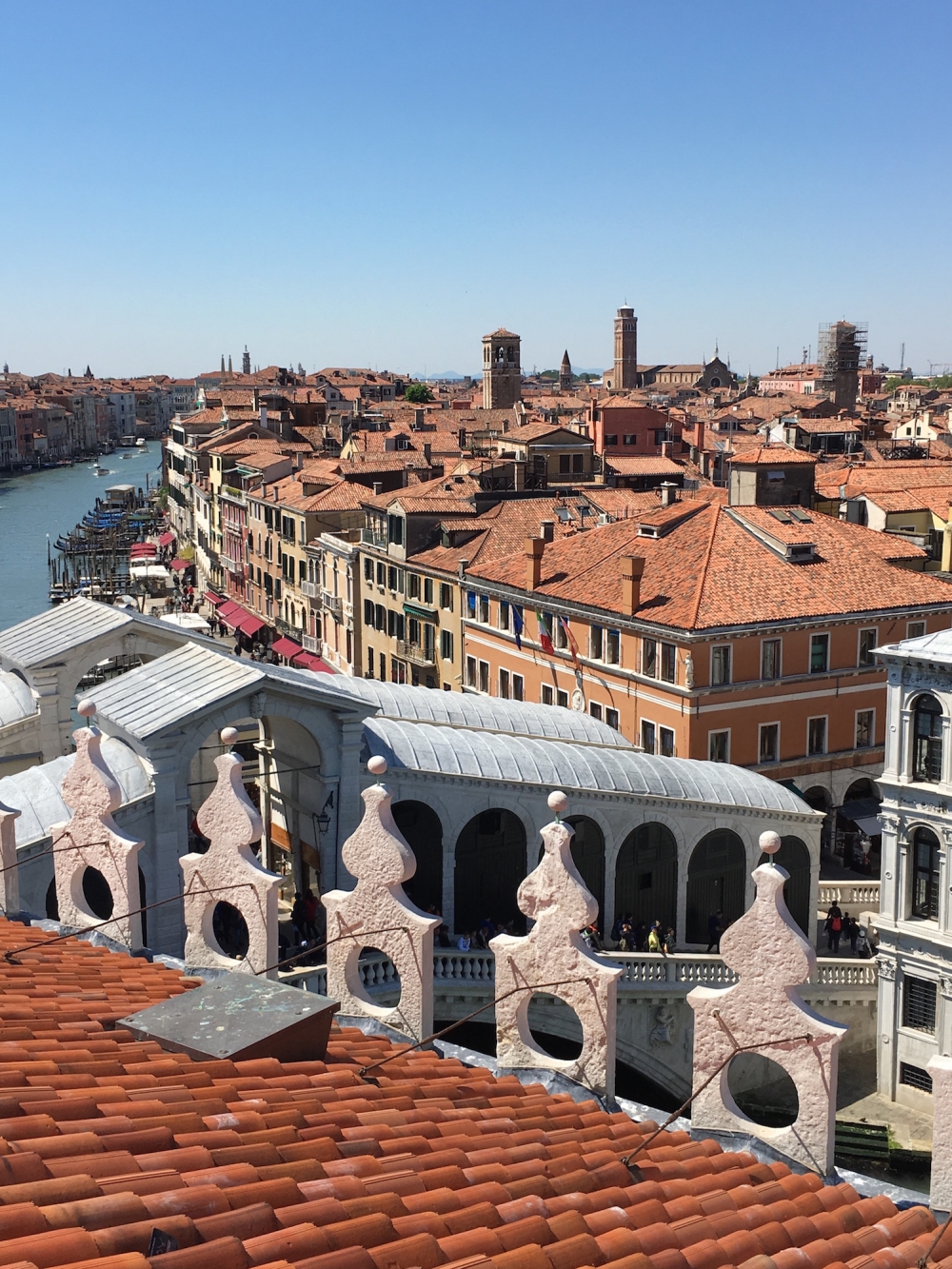
The single white Istrian stone arch spans 48 metres across the widest point of the Grand Canal. Two covered galleries run the length of the bridge, lined with small shops that have been selling goods here in one form or another for five hundred years. Standing at the centre, you're looking at one of the great urban views in Europe — gondolas moving below, palazzo facades on both banks, the canal curving away in both directions.
What to see — and what most visitors miss
The bridge itself is the landmark, but the area around it rewards a slower pace.
The Rialto Market
The Rialto Market on the San Polo side is one of Venice's most genuinely local experiences — at least in the early hours. The fish market (Pescheria) and the produce market (Erberia) have been operating here since the 11th century. Vendors unload their catch from the lagoon at dawn. By 9am, the stalls are busy with Venetian households doing their shopping. By noon, it's largely over. If you want to see it properly, get here early.
The shops on the bridge
The shops on the Rialto Bridge are worth a browse — glassware, jewellery, masks, Venetian crafts. They're genuinely on the historic bridge, which makes the setting unlike any other shopping in the city.
The Church of San Giacomo di Rialto
The Church of San Giacomo di Rialto, just beside the market, is thought to be the oldest church in Venice. Easy to walk past. Worth stepping into for a moment.
The backstreets toward Campo San Polo
The backstreets toward Campo San Polo are one of the most rewarding walks you can do from the Rialto — and one of the least obvious. Cross the bridge to the San Polo side, leave the main tourist flow behind, and follow the calli westward through one of Venice's most lived-in neighbourhoods. The campo itself is the largest square in Venice after Piazza San Marco, and almost no one ends up there by accident. It's the kind of place you find when someone who knows the city shows you the way.
Our San Polo Merchants private tour starts right here — the Rialto Bridge, the market, Campo San Polo, and the Gothic interior of the Frari Church — with a guide who knows the stories behind every corner.
San Polo Merchants — Private Walking Tour →
Video: The Rialto Bridge
Practical tips for visiting the Rialto Bridge
Come early. The bridge handles enormous foot traffic during the day — it's a narrow crossing, and with the shops on either side, it gets genuinely congested by mid-morning. Before 8am, it belongs to the market traders and the city. That's the version worth seeing.
Stop at a bacaro. The streets around the Rialto market are home to some of Venice's oldest bacari — the traditional wine bars where Venetians have been stopping for a quick ombra (a small glass of wine) and a few cicchetti since long before tourism existed. This is still very much a local ritual, especially in the late morning after the market and again in the early evening. You'll find them tucked into the calli on the San Polo side — small, standing-room-only, no menus, no reservations. Order what's on the counter, pay in cash, and move on to the next one. It's one of the most genuinely Venetian things you can do, and it costs almost nothing.
Come back in the evening. After the day tourists have moved on, the bridge has a different quality altogether — the light changes, the canal quietens, and the palazzo facades catch the last of the sun.
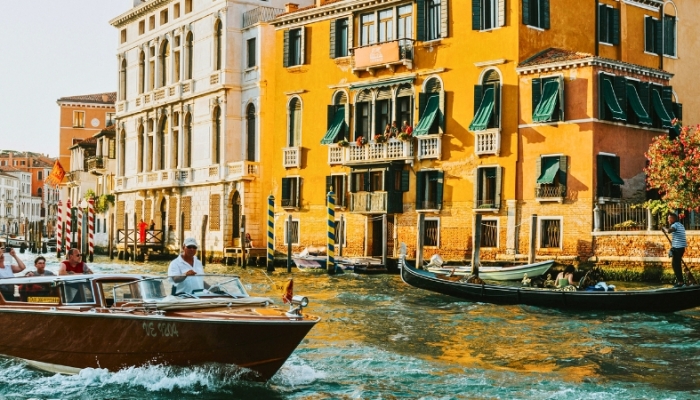
Photograph from the water. The most satisfying views of the Rialto Bridge come from a boat or vaporetto on the Grand Canal — looking up at the arch from below, or seeing it from the distance with the palazzos framing it on both sides. If you're with us on a private Grand Canal boat tour, we'll time the pass deliberately.
Wear flat shoes. The bridge is steep — shallow steps rise sharply on both sides — and the stone surface can be slippery when wet.
The best way to experience the Rialto
The Rialto Bridge is one of those landmarks that rewards context. On its own, it's beautiful and historic. Understood as part of a morning in the Rialto neighbourhood — the market, the backstreets of San Polo, Campo San Polo — it becomes something else entirely.
Our private Grand Canal Boat Tour passes beneath the bridge and includes time in the area with a guide who knows the neighbourhood. Our San Polo Merchants private tour can be designed around a Rialto morning if that's the experience you're after.
Getting to the Rialto Bridge
The Rialto Bridge sits at the heart of Venice, roughly equidistant from San Marco and the train station. The nearest vaporetto stop is Rialto on both sides of the canal (lines 1 and 2). From San Marco, it's a 15-minute walk through the calli — and a pleasant one, if you don't rush.
Rialto District: Map
If you like explore Venice in depth


Experience the Magic of Venice by Private Boat

- Walking Tour of Venice
- Doge's Palace Guided Tour
- The Ducal Venice Tour
- The Absolute Venice
- The Inside Venice Tour
- The Byzantine Venice and Gondola ride
- Morning Walking tour & Gondola Ride
- Basilica Guided Tour & Gondola ride
- The Islands Tour
- A Classic Gondola Ride Tour
- Gondola Serenade Tour
- Wine Tasting & Dinner
- The Byzantine Venice
- Classic Venice Private Tour
- Private Walking Tour
- Gondola and Walking Private Tour
- Gondola Serenade Private Tour
- Gondola and Dinner Private Tour
- The Legends of Venice
- Private Grand Canal Boat Tour
- Private Islands Tour
- Wine Tasting & Secrets of the Venetian Lagoon
- Private Luxury Cruise on the Grand Canal with Aperitif
- Wine & Cicchetti – Discover Venetian Food Traditions