Teatro La Fenice in Venice: history, rebirth and visits to the city’s temple of music
La Fenice in Venice, a symbol of opera and culture.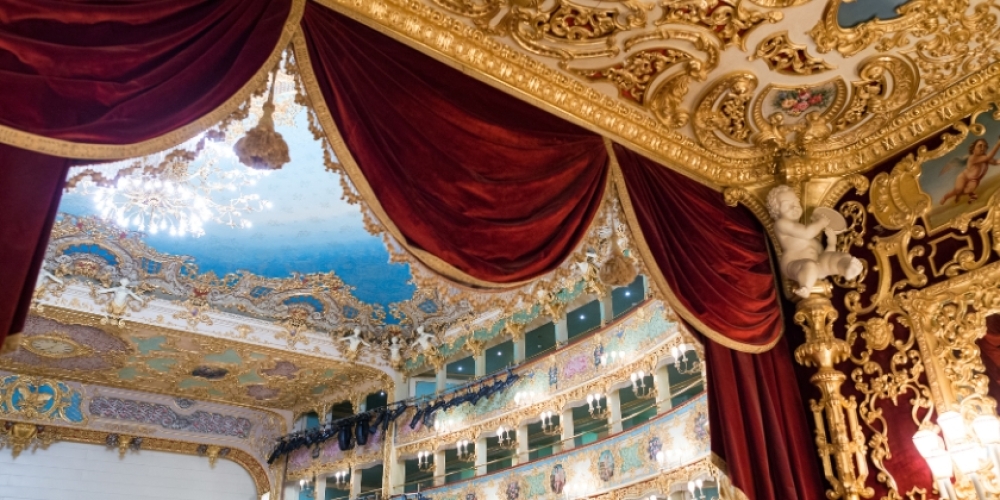
Among the most iconic and beloved cultural landmarks in Venice, Teatro La Fenice represents beauty, vulnerability and the extraordinary capacity for rebirth that defines this city. Its golden light, ivory velvet, painted ceilings and its name itself — the phoenix — reflect a destiny written in fire, music and resilience. Within these walls, two centuries of musical history have been performed, applauded and lived.
History of Teatro La Fenice
Origins (late 18th century)
Teatro La Fenice opened in 1792, commissioned by the Nobile Società dei Palchettisti — a group of Venetian noble families who had lost their previous theatre to fire. They decided to create a new, more prestigious one. The name “La Fenice” (The Phoenix) was chosen as a symbol of rebirth — and history would prove how prophetic this was.
The architectural design by Giannantonio Selva combined neoclassical elegance with superb acoustic results. The inauguration took place in May 1792 with I giochi di Agrigento by Giovanni Paisiello. From the very beginning La Fenice became the cultural heart of Venetian society and a key stage for great composers of the 19th century.
The 19th century: Verdi and legendary premieres
Throughout the 1800s, the theatre hosted premieres destined to become milestones in opera history. Here, Giuseppe Verdi premiered Ernani (1844), Attila (1846), Rigoletto (1851) and La Traviata (1853). The latter was initially poorly received — yet it would later become one of the most beloved operas ever written.
La Fenice was also a witness to Italy’s political transformations. In its theatre boxes, between arias and applause, the winds of the Risorgimento could be felt.
From the 20th century to the 1996 fire
In the 20th century, the theatre reinforced its international prestige, hosting legendary directors and performers: Maria Callas, Luciano Pavarotti, Herbert von Karajan, Claudio Abbado, Riccardo Muti. Season after season, La Fenice continued to be a point of reference in the global opera scene.
Yet the history of La Fenice is also marked by two major fires — the first in 1836, from which it was rebuilt in just 12 months, and the second on 29 January 1996, which destroyed almost the entire interior, leaving only the external walls standing.
The great fire of 1996 and the rebirth
“As it was, where it was”
The 1996 fire shocked Venice and the world. The symbol of elegance and tradition seemed lost forever. But Venice — and Italy — responded with determination. The mandate was: com’era, dov’era — “as it was, where it was”.
Reconstruction began in 2001 under architect Aldo Rossi, who faithfully recreated the theatre with modern safety standards and flame-resistant materials, restoring every detail with historical accuracy.
The reopening in 2003
On 14 December 2003, La Fenice reopened with a concert conducted by Riccardo Muti and later a new production of La Traviata. The emotion, applause and tears marked the rebirth of a theatre — and once again the triumph of Venice over destruction.
Visiting Teatro La Fenice today
A journey through gold, velvet and music
Today, Teatro La Fenice is open daily for guided visits. The tour includes the monumental foyer, the stalls, the boxes and the Royal Box — offering a privileged view of the stage and the richly decorated hall.
The visit also includes stories of the theatre, artists who have performed here, and episodes tied to unforgettable premieres. The guided visit or audioguide (available in several languages) leads the visitor through a sensory journey between history and music.
Events and performances
La Fenice hosts operas, symphonic concerts and ballet throughout the year. The main season usually runs from November to July. One of the most iconic moments is the New Year’s Concert, broadcast internationally every 1 January.
Facts & curiosities
- Capacity: approx. 1,000 seats across stalls, boxes and gallery
- Architecture: Venetian neoclassical with five tiers of boxes and gold leaf decoration
- Name: chosen because the previous theatre of the noble shareholders had burned down
- Two major fires: 1836 and 1996 — both followed by faithful reconstructions
- Symbol: rebirth, resilience, Venice’s eternal bond with art
VENICE - TEATRO LA FENICE
How to get there
Teatro La Fenice is located in the San Marco district, in Calle de la Fenice, only a few minutes’ walk from St. Mark’s Square.
By vaporetto
Line 1 or 2 → stops Santa Maria del Giglio or San Marco Vallaresso. From either stop, the theatre is about a 5-minute walk.
On foot
From St. Mark’s Square, walk along Calle Larga XXII Marzo, then Calle de la Veste and finally Calle de la Fenice. The main entrance is marked by a golden sign and a small bridge.
Accessibility
The theatre is accessible for visitors with reduced mobility. An elevator and accessible routes are available along the official visit path.
What to see nearby
Teatro La Fenice stands in a highly atmospheric area. Only a few steps away you’ll find:
- St. Mark’s Square – with the Basilica and the Bell Tower
- Palazzo Contarini del Bovolo – famous for its spiral staircase
- Calle Larga XXII Marzo – luxury boutiques and historic cafés
- Palazzo Fortuny – museum dedicated to Mariano Fortuny
- Campo Santo Stefano – a lively campo with gothic façades and local vibe
Tips for visiting
To experience La Fenice at its best:
- Visit early in the morning or late afternoon for softer, golden natural light
- Allow at least one full hour for the visit
- For evening performances → elegant dress code recommended
- Don’t miss the theatre bookshop — beautiful souvenirs and publications
A symbol of Venice
Visiting Teatro La Fenice means touching Venice’s musical history — and its resilience — with your own eyes. Every detail, from the curtain to the gilded boxes, tells a story of passion and rebirth. It is a place that, like the phoenix, continues to rise again to enchant and inspire those who enter.
Next page: explore the 2025/26 Theatre Season with all scheduled operas, concerts and events.
- Walking Tour of Venice
- Doge's Palace Guided Tour
- The Ducal Venice Tour
- The Absolute Venice
- The Inside Venice Tour
- The Byzantine Venice and Gondola ride
- Morning Walking tour & Gondola Ride
- Basilica Guided Tour & Gondola ride
- The Islands Tour
- A Classic Gondola Ride Tour
- Gondola Serenade Tour
- Wine Tasting & Dinner
- The Byzantine Venice
- Classic Venice Private Tour
- Private Walking Tour
- Gondola and Walking Private Tour
- Gondola Serenade Private Tour
- Gondola and Dinner Private Tour
- The Legends of Venice
- Private Grand Canal Boat Tour
- Private Islands Tour
- Wine Tasting & Secrets of the Venetian Lagoon
- Private Luxury Cruise on the Grand Canal with Aperitif
- Wine & Cicchetti – Discover Venetian Food Traditions