How to Visit San Giorgio Maggiore in Venice
An all-Venetian experience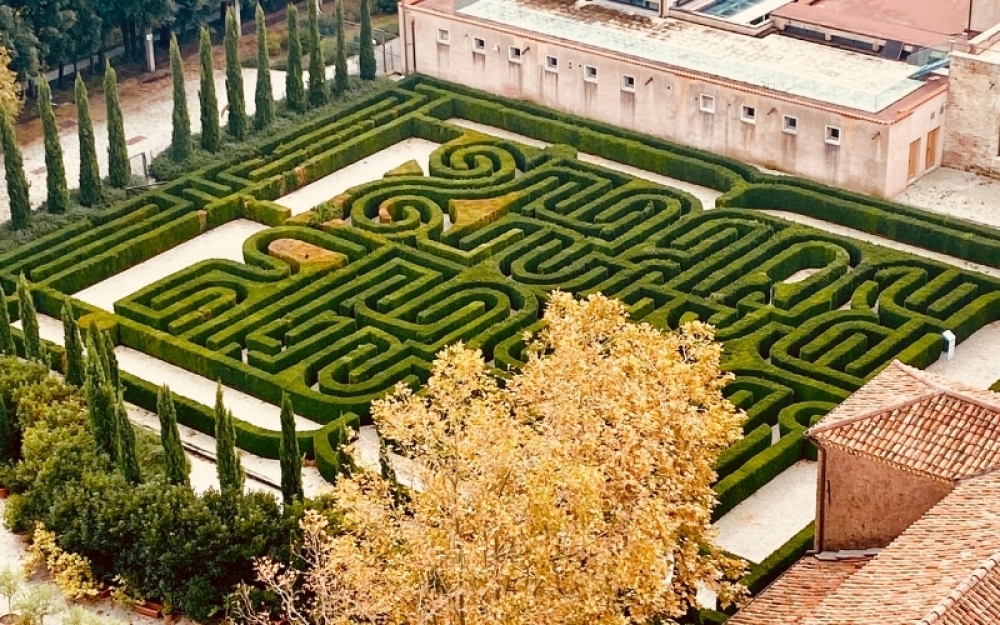


Why Visit the Island of San Giorgio Maggiore
Facing St. Mark’s Square and separated by just a few minutes by vaporetto, one of Venice’s most fascinating and often overlooked islands awaits: San Giorgio Maggiore. Here, the rhythm changes, the noise of the crowds fades, and the city reveals itself in a quieter, more elegant, and contemplative dimension.
Visiting San Giorgio Maggiore means discovering a place that brings together art, architecture, and extraordinary views in a setting that feels intimate yet deeply meaningful. The famous basilica designed by Andrea Palladio, the bell tower with one of the most beautiful panoramas over Venice, and the monumental complex of the Fondazione Giorgio Cini make this island an essential stop for anyone who wants to experience the city from a different perspective.
Unlike other central areas, here you can take a break from the tourist crowds without truly leaving the heart of Venice behind. It is precisely this balance between central location and quiet atmosphere that makes San Giorgio Maggiore one of the most surprising experiences in the Venetian lagoon.
The History of the Island of San Giorgio Maggiore
The origins of the island of San Giorgio Maggiore date back to the early Middle Ages, but its development is especially tied to the presence of the Benedictine order, which established here one of the most important religious centers in the Venetian lagoon.
Over the centuries, the monastic complex gained increasing importance, becoming not only a place of spirituality but also a cultural and intellectual landmark. The island was expanded and transformed several times, gradually taking on the monumental appearance we admire today.
The defining moment in the architectural identity of the island came in the 16th century, when the Republic of Venice entrusted Andrea Palladio with the design of the new basilica. The result is one of the most harmonious examples of Renaissance architecture, perfectly capable of engaging with the open space of the lagoon.
After the fall of the Republic and during the Napoleonic era, the monastery went through a period of decline. In the 20th century, however, the island entered a new chapter thanks to the creation of the Fondazione Giorgio Cini, which transformed the complex into an important international cultural center.
Today, San Giorgio Maggiore represents a perfect balance between past and present: a place where monastic history, Renaissance architecture, and contemporary cultural research coexist in one of the most evocative settings in Venice.
The Basilica of San Giorgio Maggiore: History, Art, and Architecture
The spiritual and monumental heart of the island is the Basilica of San Giorgio Maggiore, one of the absolute masterpieces of Andrea Palladio and one of the most elegant buildings of the Venetian Renaissance. The design of the new church was entrusted to Palladio in the 16th century and still stands today as one of the purest expressions of his idea of classical harmony, based on balance, proportion, and light. The basilica we see today was completed in 1610, faithfully following Palladio’s original design.
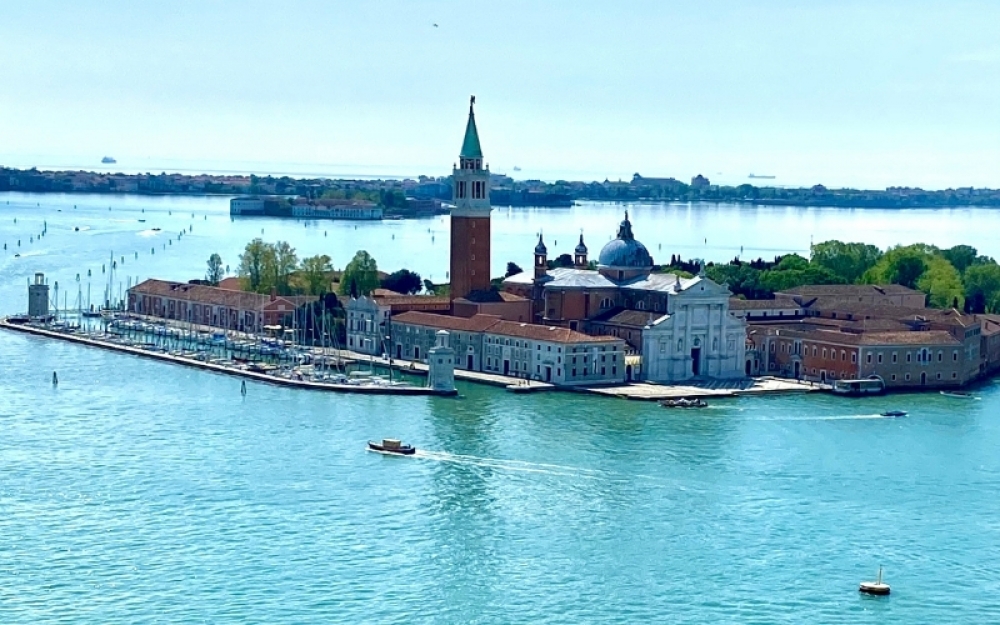
Its white and solemn façade is one of the most recognizable elements of the Venetian skyline. Looking at it from the St. Mark’s Basin, it becomes immediately clear why San Giorgio Maggiore is so deeply rooted in the city’s visual identity: the church rises above the water with extraordinary compositional strength, yet never feels heavy. Palladio succeeded in reinterpreting classical language in a Venetian way, creating a façade that combines monumentality with lightness.
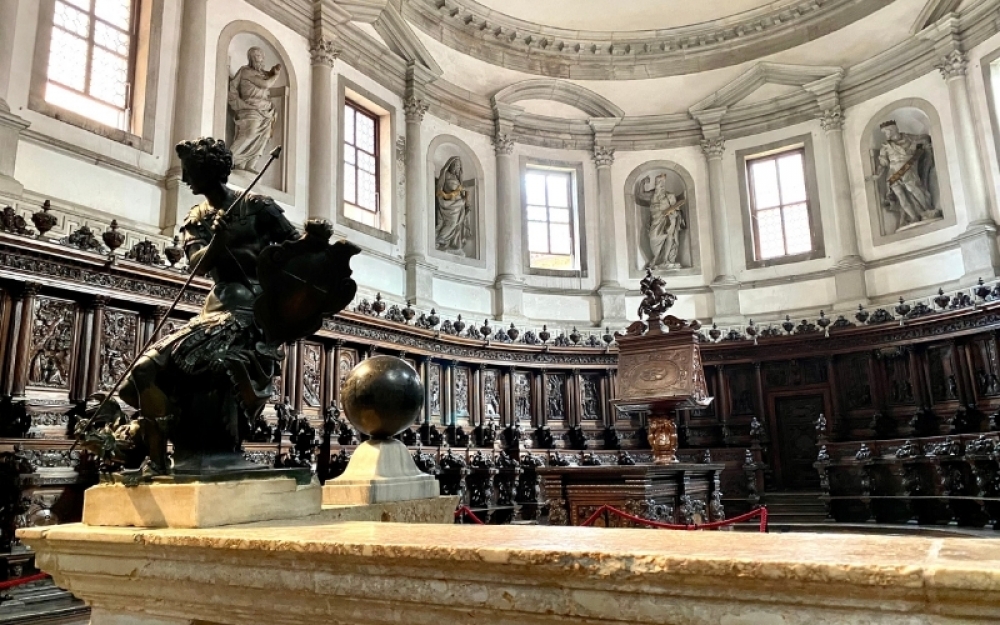
The interior is equally striking for its sense of measure. Unlike many Venetian churches rich in decoration and color, what prevails here is a feeling of order, clarity, and light. The proportions are designed to guide the eye naturally, while the architecture creates an almost meditative atmosphere. It is a space that invites visitors to slow down, observe, and be guided more by the geometry of the whole than by immediate visual spectacle.
The basilica also preserves important works of art and remains a living place in both religious and cultural terms. It is precisely this continuity between liturgical function, artistic value, and architectural beauty that makes the visit especially meaningful: you are not entering a simple monument, but a place that has been part of Venice’s spiritual and cultural history for centuries.
The Bell Tower of San Giorgio Maggiore and the Panoramic View
If the basilica is the monumental heart of the island, the bell tower of San Giorgio Maggiore is undoubtedly one of the main reasons why the island is worth visiting. The current bell tower was rebuilt in 1774 and today offers one of the most beautiful and well-balanced panoramas in all of Venice. From the top, visitors can enjoy an extraordinary view over the St. Mark’s Basin, the lagoon, and the skyline of the historic center.
Many visitors consider it one of the best panoramic viewpoints in the city, and it is easy to understand why. From here, Venice reveals itself in a complete yet perfectly readable way: in front of you are St. Mark’s Square, the Doge’s Palace, the Basilica, Punta della Dogana, and the Grand Canal; all around stretches the lagoon, with its islands, reflections, and ever-changing light.
Compared to St. Mark’s Campanile, the perspective from San Giorgio has a different charm. You are not looking at the city from within its most monumental core, but from a slightly more removed and therefore more scenic position. It is the ideal place to truly understand the relationship between Venice and the water, between architecture and lagoon space, between the historic center and its surrounding landscape.
Climbing the bell tower is especially recommended for photography lovers, but also for anyone seeking a quiet, contemplative moment. On clear days, the view is broad and luminous; at sunset, the panorama takes on softer and richer tones, making the experience even more memorable.
The Fondazione Giorgio Cini and the Island’s Cultural Side
Visiting San Giorgio Maggiore also means discovering that the island is not only home to an extraordinary basilica, but also one of Venice’s most important cultural centers. Much of the monumental complex is now connected to the Fondazione Giorgio Cini, an institution that has transformed the island into a place of study, research, exhibitions, guided visits, and international cultural activity. In fact, the foundation played a decisive role in the restoration and revitalization of San Giorgio Maggiore during the 20th century and continues to promote its cultural value today.
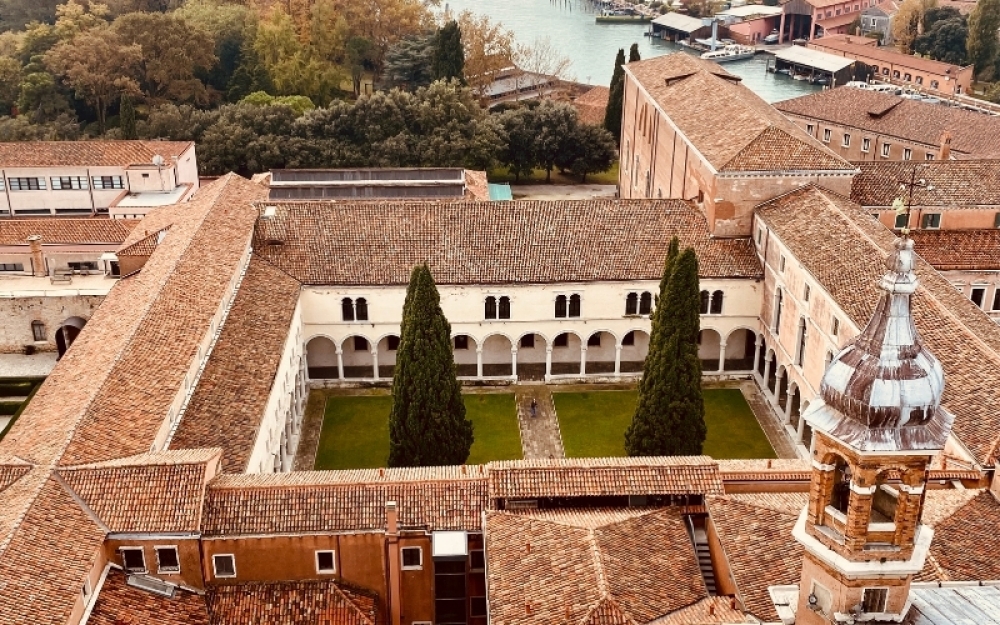
The foundation’s complex includes cloisters, exhibition spaces, libraries, research institutes, and monumental areas that go far beyond the idea of a simple religious visit. This diversity is precisely what makes the island so interesting: those who arrive at San Giorgio Maggiore can choose a short experience focused on the basilica and bell tower, or devote more time to a broader cultural visit.
In recent years, the range of experiences has grown even richer thanks to itineraries dedicated to the Fondazione Giorgio Cini, the Borges Labyrinth, the woodland with the Vatican Chapels, and the Green Theater, all of which confirm that San Giorgio Maggiore is now a destination where spirituality, architecture, landscape, and contemporary culture come together. The official visits offered by VisitCini combine several routes across the island and turn San Giorgio into a truly complete cultural experience.
For this reason, anyone who includes San Giorgio Maggiore in a Venice itinerary is not simply visiting a beautiful church: they are discovering an island that tells the deeper story of Venice’s relationship with art, research, and the lagoon landscape, in one of the city’s most refined and understated settings.
How to Reach San Giorgio Maggiore
Getting to San Giorgio Maggiore is very easy, and it is precisely this ease of access that makes it such an appealing stop. Although it is located on an island separated from the historic center, San Giorgio is in fact just a few minutes from St. Mark’s Square and can easily be included in a day of sightseeing in the heart of Venice.
The most practical way to get there is by vaporetto. The crossing is short and scenic: simply board a line that connects the St. Mark’s Basin to the island, and within just a few minutes you will find yourself in a completely different setting—quieter, more open, and more orderly. This short journey across the water is part of the experience itself, because it allows you to admire Venice from a privileged perspective even before you arrive.
For many visitors, the most convenient starting point is the area of San Zaccaria, or more generally the San Marco waterfront. From here, San Giorgio Maggiore appears clearly in front of you, with its basilica and bell tower creating one of the most elegant silhouettes in the city. Because of this proximity, the island is perfectly suited to a visit of just a few hours or to a cultural detour during a day in the historic center.
Those who wish to organize their itinerary well can easily combine San Giorgio Maggiore with places such as St. Mark’s Square, the Doge’s Palace, the Riva degli Schiavoni, or, in a broader route, even the Giudecca area. In any case, the feeling upon arrival is always the same: in just a few minutes, you move from the most monumental and crowded heart of Venice to a space that feels much more intimate and contemplative.
How Much Time You Need to Visit the Island
The time needed to visit San Giorgio Maggiore can vary considerably depending on the kind of experience you want to have. Those who want an essential visit focused on the basilica and the panoramic bell tower should allow about 45 minutes to 1 hour. This is the ideal option for travelers with a busy schedule who still do not want to miss one of the best views in Venice.
Those who would like to explore the island at a more relaxed pace, perhaps including the routes of the Fondazione Giorgio Cini, any exhibitions, or a longer stop to admire and photograph the St. Mark’s Basin, should plan for at least half a day.
This flexibility is one of the great advantages of San Giorgio Maggiore. The island can be experienced in many different ways: as a short and focused visit, as a broader cultural stop, or as a place to slow down and observe Venice from a minimal distance but from a completely new perspective.
For this reason, the best advice is not to think of San Giorgio Maggiore as a simple “quick excursion,” but rather as a destination that can adapt to the pace and interests of each visitor.
Who This Visit Is Recommended For
San Giorgio Maggiore is particularly well suited to those who want to discover a quieter, less predictable side of Venice while still remaining just steps away from its most famous landmarks. It is a recommended visit for very different kinds of travelers, precisely because it brings together art, panoramic views, spirituality, and atmosphere.
It is perfect for:
- those who love Renaissance architecture and want to see one of Andrea Palladio’s great masterpieces up close;
- those looking for an extraordinary panoramic viewpoint that is less crowded than other iconic places in the city;
- photographers and lovers of lagoon scenery;
- couples and travelers looking for a quieter and more evocative stop;
- those who have already visited Venice’s great classics and want to add a more refined and less obvious place to their itinerary;
- visitors interested in combining the religious dimension of the basilica with the cultural experience of the Fondazione Giorgio Cini.
The island is also especially appreciated by those who love places where beauty does not impose itself immediately, but gradually reveals itself through light, silence, balanced proportions, and open views across the lagoon.
What to See Near San Giorgio Maggiore
Another great advantage of San Giorgio Maggiore is its location. Although it is on an island, it lies very close to some of Venice’s most famous and scenic landmarks. This makes it perfect to combine with other sites, either on the same day or within the same walking and vaporetto itinerary.
The easiest visits to pair with San Giorgio Maggiore include:
- St. Mark’s Square, located directly opposite and the natural starting point for reaching the island;
- St. Mark’s Basilica and the Doge’s Palace, ideal for building an itinerary around the city’s major monumental symbols;
- the Riva degli Schiavoni, perfect for a waterfront walk before or after the crossing;
- the Giudecca, for those who want to continue toward an even more residential and less touristy side of Venice;
- Punta della Dogana, which from the basin offers one of the most beautiful visual dialogues with San Giorgio Maggiore.
From a landscape point of view, few places offer such a direct relationship with Venice’s skyline. Visiting San Giorgio also means looking at the historic center from the outside, understanding more clearly its form, its position on the water, and the bond between architecture and lagoon.
Useful Tips for Visiting San Giorgio Maggiore
To truly appreciate San Giorgio Maggiore, it is best to visit it at a relaxed pace. This is not a place to rush through, but one to experience slowly, allowing yourself to be guided by the light, the silence, and the beauty of the whole setting.
A few practical tips can make the visit even more enjoyable:
- reach the island in the early morning or late afternoon, when the light is softer and the atmosphere even more evocative;
- if you plan to climb the bell tower, choose a clear day to enjoy the panorama at its best;
- consider combining the basilica visit with the cultural routes of the Fondazione Giorgio Cini, in order to experience the island more fully;
- always check in advance for possible changes in opening hours, special visits, or exceptional openings;
- bring your camera or smartphone: San Giorgio Maggiore is one of the most photogenic places in Venice, both from the island itself and when looking back at Venice across the basin.
Finally, the most important advice may also be the simplest: do not limit yourself to merely “seeing” San Giorgio Maggiore, but give yourself time to stop. Even just a few minutes spent in front of the basilica façade or at the top of the bell tower are enough to understand why this island is one of the most elegant and underrated places in the city.
Visiting San Giorgio Maggiore in 2026: Opening Hours, Tickets, Tours, and Updates
A visit to San Giorgio Maggiore may vary throughout the year depending on the season, special events, cultural programming, and the schedule of the Fondazione Giorgio Cini. For this reason, practical information should always be considered indicative and subject to updates.
In 2026, the island continues to be accessible through different types of visits, allowing travelers to discover not only the basilica and the bell tower, but also the rich cultural heritage of the monumental complex.
Opening Hours
The Basilica of San Giorgio Maggiore is generally open every day, with opening hours that may vary between morning and afternoon, especially depending on religious services.
The panoramic bell tower is accessible for much of the day, although opening times may occasionally change due to weather conditions or technical needs.
The areas managed by the Fondazione Giorgio Cini, including cloisters, cultural routes, and guided visits, instead follow a specific schedule with set times depending on the chosen itinerary.
Tip: before your visit, always check the most up-to-date opening hours on the official websites in order to avoid last-minute changes.
Tickets and Visiting Options
Access to the basilica is generally free, while:
- entry to the bell tower requires a ticket;
- visits to the Fondazione Giorgio Cini and its cultural itineraries require a dedicated admission ticket;
- some routes, such as guided visits or access to specific areas, may only be available by reservation.
Prices may vary depending on the type of experience selected and the season.
Exhibitions and Events
Throughout the year, San Giorgio Maggiore hosts temporary exhibitions, cultural events, artistic installations, and initiatives related to research and heritage enhancement.
In particular, the Fondazione Giorgio Cini regularly organizes:
- art and photography exhibitions;
- thematic routes within the monumental complex;
- cultural and musical events;
- special visits to spaces that are not normally open to the public.
These activities make the island dynamic and ever-changing, even for those who have visited it before.
Useful Notes for 2026
To plan your visit in the best possible way in 2026, it is advisable to:
- always check the official websites before your visit;
- consider booking in advance for the most requested itineraries;
- keep in mind that some areas may have limited access or specific opening hours;
- take seasonality into account, especially during the busiest months.
This section is updated every year in order to provide current practical information about opening hours, tickets, and activities available on the island.
Why San Giorgio Maggiore Is Worth Visiting
San Giorgio Maggiore is not only one of the most iconic views in Venice, but also one of the places where the city becomes easier to understand. From here, the relationship between water, architecture, and space becomes clear, and Venice reveals itself in all of its harmony.
It is an island that brings together art, spirituality, panoramic beauty, and culture, offering an experience that feels complete yet relaxed, far from the chaos of the city’s busiest areas.
Whether you are planning a quick visit or a more in-depth exploration, San Giorgio Maggiore always leaves something behind: a different way of looking at the city, a moment of silence, a new perspective.
A place that, despite being just a few minutes from San Marco, feels as if it belongs to another Venice.
- Walking Tour of Venice
- Doge's Palace Guided Tour
- The Ducal Venice Tour
- The Absolute Venice
- The Inside Venice Tour
- The Byzantine Venice and Gondola ride
- Morning Walking tour & Gondola Ride
- Basilica Guided Tour & Gondola ride
- The Islands Tour
- A Classic Gondola Ride Tour
- Gondola Serenade Tour
- Wine Tasting & Dinner
- The Byzantine Venice